Digital Transformation & Risk Management
Leadership Consulting Coaching Resilience
Clarity for complexity. Capability worthy of trust.
OSI Network helps leaders and organizations navigate consequential challenges at the intersection of technology, risk, security, leadership, and operations. We bring intelligence-informed judgment, practical experience, and disciplined execution together so organizations can see what matters, strengthen capability, and move forward with greater resilience.
Where complexity converges
OSI operates where technology, security, risk, leadership, and operations affect one another. Some engagements begin with a technical problem. Others begin with operational disruption, organizational risk, security requirements, or leadership strain. The work begins by understanding the environment before prescribing the answer.

Technology increasingly touches every part of the operating environment. Systems, cybersecurity, data, AI, communications, and infrastructure must work together without allowing complexity to outrun leadership or mission.
OSI helps organizations align technology with operational requirements, security, resilience, and responsible human decision-making.

Organizations do not experience risk one issue at a time. Operational pressure, security concerns, leadership decisions, technology dependence, and external disruption often converge in the same environment.
OSI helps leaders understand those conditions as an integrated decision space, so they can reduce avoidable risk, strengthen resilience, and respond with greater clarity and discipline.

Organizations change only as effectively as the people responsible for leading them through it. Strategy, technology, and process matter, but lasting improvement requires trust, judgment, communication, and the ability to bring people with the mission.
OSI helps leaders and organizations navigate complexity, strengthen decision-making, align people and systems, and build the capability needed to lead through change with clarity and purpose.

Applied Intelligence for Leaders Responsible for What Comes Next
Complex operating environments change faster than conventional planning cycles. OSI Foresight examines developments in supply chains, technology, organizational resilience, leadership, risk, and the wider operating environment to help decision-makers recognize meaningful change before their options narrow.
The objective is not prediction for its own sake. It is better judgment: understanding what changed, why it matters, where uncertainty remains, and what responsible leaders should consider next.
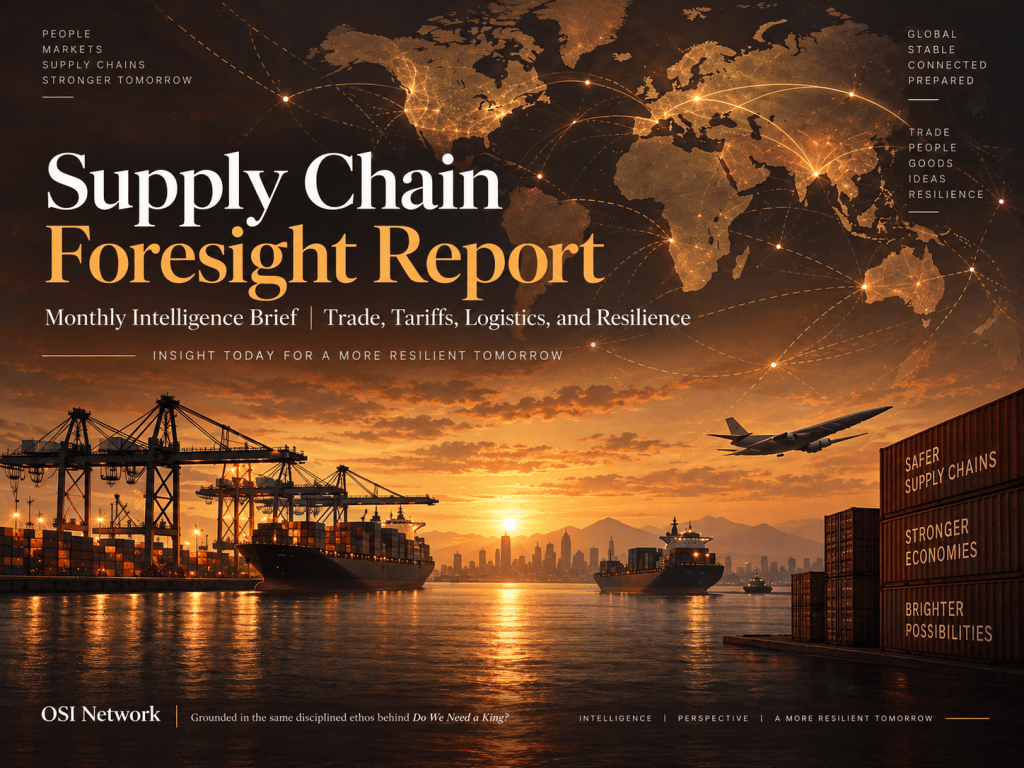
Supply Chain Foresight
Global supply chains are no longer simply logistics systems. They are increasingly shaped by geopolitical competition, technology dependence, energy markets, conflict, infrastructure risk, trade policy, cyber disruption, and the strategic decisions of governments and industry.
Supply Chain Foresight examines those forces as an interconnected operating environment. Rather than reporting disruption after it occurs, OSI looks for the conditions that may change access, cost, availability, resilience, and decision space before their consequences become obvious.
The purpose is practical. Leaders need to understand not only what is happening, but what may follow, what assumptions deserve reconsideration, and where earlier action may preserve options. Our analysis connects global developments to the operational realities organizations and communities may eventually experience at home.
See beyond the disruption. Understand what comes next.

Enterprise Risk Management
Risk rarely remains inside the category where it begins. A technology problem can affect operations. A personnel decision can create security exposure. Weak communication can become organizational risk. Changes in markets, supply chains, leadership, culture, or technology can create problems and opportunities long before they become crises.
OSI approaches Enterprise Risk Management as a leadership and decision discipline rather than a compliance exercise. We examine the relationships among people, risk, security, technology, operations, and organizational culture so leaders can understand what is changing, what matters, and where action may preserve future options.
Security is an important part of that picture, but security alone is not risk management. Effective ERM requires leaders to distinguish existing problems from uncertain risks, recognize emerging opportunities, understand dependencies, and consider how decisions in one part of the organization may create consequences elsewhere.
The objective is not to eliminate uncertainty. It is to help organizations make better decisions within it—strengthening resilience, protecting people and resources, and building the capability to adapt before disruption removes the choices that remain.
Understand the risk. Preserve the options. Strengthen the organization.